
By Haroon Ali, Cricket Writer at Everything About Cricket | Last updated: November 2026
Quick Answer: How Do You Hit Sixes in Tape Ball Cricket?
To hit sixes in tape ball cricket, wait for a ball in your hitting zone, get your feet into position, keep your head still, and swing through the line of the ball with a smooth, full follow-through. Contact should happen slightly in front of your body, in the middle of the bat. Power comes from timing and body rotation, not from arm strength alone.
A taped tennis ball is light, skids on after pitching and does not bounce as high as a hard ball. That means a clean strike clears the rope far more often than a wild heave. Here is the short version:
- Pick the right ball. Attack full balls, half-volleys and balls on your pads. Leave wide, awkward or very good yorker-length deliveries alone.
- Set a balanced stance. Feet shoulder-width apart, knees soft, head still and eyes level.
- Read the length early. Watch the bowler’s hand and the ball out of the hand, not the bowler’s run-up.
- Move your feet. Get close to the pitch of the ball or create room, so you can swing freely.
- Rotate and accelerate. Drive with your hips and shoulders and let the bat speed build through the ball.
- Hit through the line and finish. Make contact in front of your body and complete the follow-through without stopping the bat.
The rest of this guide explains each step in depth, with the reasons behind it, shot-by-shot advice, practice drills and a four-week training plan.
Key Takeaways
- Timing beats strength. A well-timed shot from the middle of the bat travels further than a mistimed full-power swing.
- Shot selection matters as much as technique. Good six-hitters choose the ball, they do not just swing at every delivery.
- Tape ball is different from hard ball. The ball skids, swings early and dips late, so your reading of length has to be quick.
- Practice in stages: timing first, placement second, power last.
- Safety first. Clear your hitting area of people, windows and vehicles before you practice.
Why Sixes in Tape Ball Cricket Are Different From Hard Ball
Before working on technique, it helps to understand the ball you are hitting. A tape ball is usually a tennis ball wrapped in electrical or PVC tape. The tape makes it heavier on the surface, much faster through the air and far slicker off the pitch than a plain tennis ball. If you want the full comparison, read our guide on tape ball vs hard ball cricket.
For a batter trying to hit sixes, these differences matter in practical ways:
- The ball skids rather than bouncing high. You often have less time than the bowler’s pace suggests, and the ball tends to come onto the bat at a lower height. This favors straight-batted lofted drives and flat hits over high, hanging shots.
- Swing and dip can be sharp. A new taped ball can swing early, and many bowlers use dip or a late drop to beat the bat. Judging length early is more important than in most formats.
- The ball changes as the innings goes on. Tape wears, the surface gets scuffed and a wet ball becomes heavy. A ball that was easy to clear in the first over can behave differently by the sixth.
- Boundaries are often short. In street and ground matches, a mistimed lift can still carry over the rope. That tempts players to swing wildly, but consistent hitters still aim for the middle of the bat.
- Conditions are less controlled. Uneven surfaces, wind and different local rules mean you must adapt your plan from match to match.
Tape ball cricket is also played with many local variations in rules. For the standard rules and terms used in this guide, see our cricket rules page. For the official laws of the game, including how a six is scored, you can consult the MCC Laws of Cricket.
Your Setup: Bat, Grip, Ball and Ground
Good sixes start before the first delivery.
The bat. Many tape ball players use thick-edged, heavier bats, often made from Kashmir willow, because the sweet spot is forgiving and the ball is light. Heavier is not always better. The right bat is one you can swing quickly and under control for a full innings. If you cannot get the bat through the hitting zone smoothly, it is too heavy for you. Younger players should use a bat sized for their height and strength.
The grip. Hold the handle firmly but not tightly. A common cue is to grip it like a bird: firm enough that it cannot fly away, gentle enough that you do not crush it. A tense grip slows the wrists and reduces bat speed. Keep your top hand in control of the direction and let your bottom hand add power.
The ball. Check the tape. A loosely wrapped ball behaves differently from a tight one, and a damaged ball can change direction unpredictably. Agree on the ball with your team before the match.
The ground. Walk the boundary before you bat. Note the shortest side, where the wind is blowing and where the fielders usually stand. A thirty-second walk can show you where your sixes are most likely to come from.
Technique 1: Build a Balanced Batting Stance
Your stance is the base for everything else. If it is unbalanced, your footwork, timing and bat speed all suffer.
Stand with your feet about shoulder-width apart, knees slightly bent and weight on the balls of your feet. Keep your head still and your eyes level, so both eyes can see the bowler. Let your shoulders stay relaxed and keep your backlift smooth and straight, in the line of the stumps rather than looping across your body.
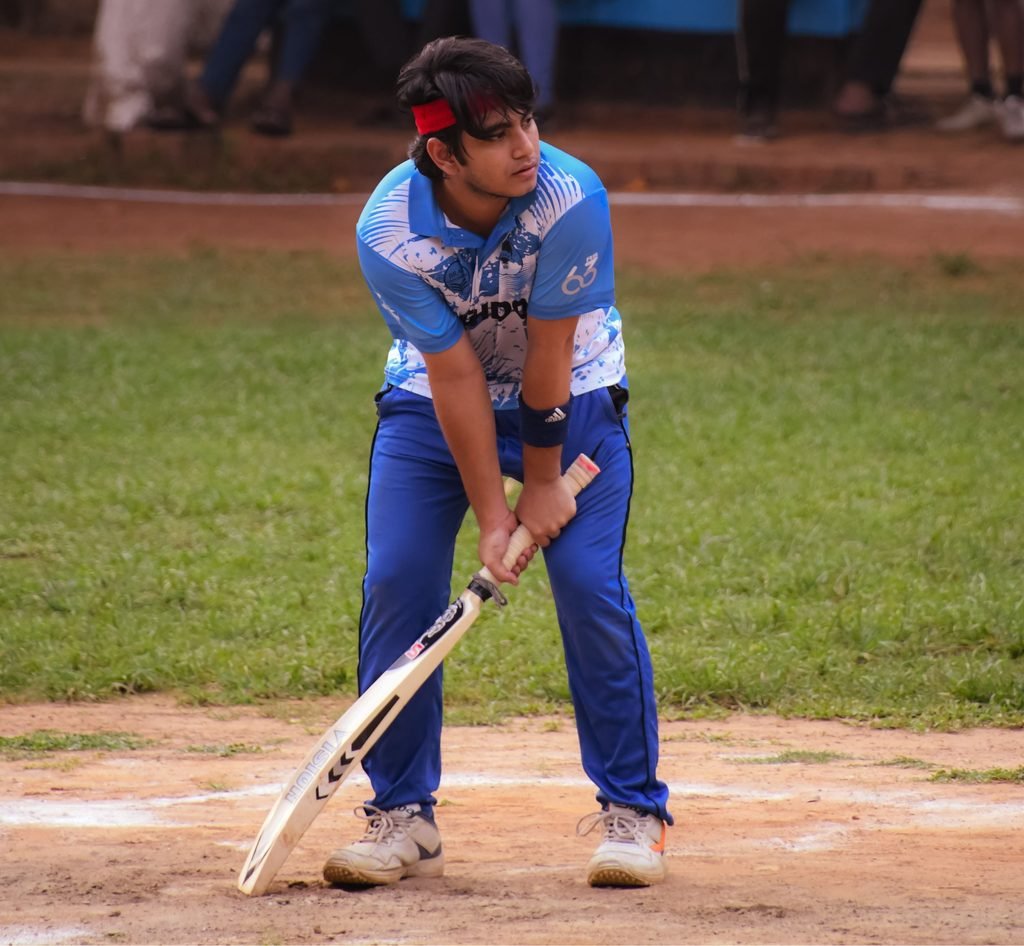
A good stance lets you move forward or back without having to adjust first. If you notice you are leaning towards the leg side or standing too stiffly, you are likely to be late against quick bowlers and tape ball fast bowlers are quick to exploit that.
Quick stance check:
- Head over the line between your feet
- Weight evenly spread, ready to move
- Hands relaxed, bat lifted straight
- Eyes level, watching the bowler’s hand
Technique 2: Read the Length Early
In tape ball cricket, the ball arrives quickly and skids, so the batter who reads length early wins. Start watching the bowler’s hand at the point of release. Look for the position of the wrist and fingers, because that tells you whether it is a slower ball, a knuckle ball or a quicker delivery.
Then, decide quickly: is it full, good length or short?
- Full or half-volley: your best chance to hit straight and flat, or loft over mid-off and mid-on.
- Slightly short, on the pads: a chance to hit through midwicket, or over cow corner.
- Good length, on the stumps: often better to rotate the strike unless the field is very deep.
- Wide, too short or yorker length: a risky ball for a six. Leave it, defend it or take a single.
The key is to decide before the ball pitches. A late decision usually means a mistimed shot.
Technique 3: Use Small, Purposeful Footwork
Most missed sixes come from poor positioning, not weak arms. Good footwork gets you close enough to swing through the ball without reaching for it.
For a full ball, take a controlled step forward and let your front knee bend. Keep your head over the ball and your balance steady. For a short ball, shift back and across slightly, creating room to swing your arms. If the bowler is fast, keep your movements small. Large steps make you lose sight of the ball.
A useful rule is to move your feet so the ball arrives in your hitting zone, rather than reaching for the ball with your hands. If you find yourself stretching away from your body, your feet have not done their job.
Technique 4: Hit Slightly in Front of Your Body
Contact point is the difference between a six and a catch. Aim to make contact just in front of your body, with your head still and your eyes on the ball until the last moment. Hitting the ball too late, level with or behind your body, usually produces a top edge or a skied catch.
Keep your head still for a split second after contact. Players who look up too early to see where the ball is going often lift their head and pull their bat off line. Finish the shot first, then watch it fly.
If you struggle with contact, return to throwdown practice (see the drills section below) and focus only on hitting the middle of the bat. Distance follows clean contact.
Technique 5: Generate Power From Your Whole Body
Power is a chain. It starts from the ground, moves through your legs and hips, flows through your shoulders and finishes through your hands and the bat. If any link is weak, you lose power.
- Base: Keep your feet stable and your balance steady through the shot.
- Hips: Rotate your hips towards the target as you swing.
- Shoulders: Let them follow the hips. Do not open them too early.
- Hands and wrists: Let the bat accelerate through the ball. Wrists should be relaxed until just before contact.
- Follow-through: Let the bat finish naturally. Stopping the swing at contact reduces power.
A common mistake is to swing with the arms only. This produces weak, mistimed hits. When you feel the power coming from your legs and hips, the shot feels almost effortless and the ball travels further.
Technique 6: Hit Straight Sixes With a Lofted Drive
The straight six is the most controlled big shot because the bat travels along the same line as the ball. Use it for full deliveries and half-volleys.
- Get your front foot close to the pitch of the ball without losing balance.
- Keep your head over the ball and your front shoulder pointing towards the bowler.
- Swing the bat through the line of the ball with a slight upward angle.
- Make contact in front of your body, with the bat face straight.
- Finish high, with a full extension of the arms and a balanced finish.
Avoid leaning back to lift the ball. A back-leaning posture reduces control and makes it easy to hit the ball up rather than out. If the bowler is quick, make sure you commit to the shot only when the ball is full enough.
Technique 7: Clear the Leg Side and Cow Corner
The leg side is the favorite scoring zone in tape ball cricket because many players find it easier to generate power across the line. The classic shot is the slog over midwicket or cow corner.
Choose balls on your pads, on middle stump or slightly short. Use your feet to get into a position where you can rotate your body and swing through the line. Keep your head still and let your hips drive the swing.
Be careful with balls outside off stump. Pulling them across the line is risky because the bat angle makes it difficult to control the direction. If the field is set deep on the leg side, think twice and consider hitting straight or over the off side instead.
Smart batters change the angle. If everyone expects you to hit over midwicket, a straight six or an inside-out lofted drive over cover can catch the field off guard.
Technique 8: Play the Pull and the Lofted Cover Drive
Two more shots give you range:
The pull. Use it on short balls that sit up at a comfortable height. Get your back foot back and across, turn your hips, and roll your wrists over the ball only if you are balanced. The pull is high-risk against fast bowlers if you are late, so only use it when you have seen the ball early. If you are not sure whether you can reach it, defend it instead.
The lofted cover drive. Use it for full balls outside off stump. Step towards the pitch of the ball and open the bat face slightly as you swing through. This shot needs a good base. Do not lean away from the ball and do not push your hands too far ahead of your body.
Having these options means the bowler cannot bowl to a single predictable line.
Technique 9: Choose the Ball and Read the Match
The best sixes come from smart cricket, not from reckless swinging. Before you commit to a six, ask three questions:
- Is the ball within my hitting zone?
- Am I balanced and able to get my feet in position?
- Is there space to hit it into, and what is the risk if I mistime it?
Think about the match situation too:
- Early overs: The ball swings more. Concentrate on building a platform and picking off loose balls.
- Middle overs: Look to rotate the strike and attack the shortest boundary.
- Final overs: Be bolder, but still pick the ball. Many wickets fall from panic shots rather than good bowling.
- Windy conditions: Use the wind to your advantage, but remember it can also push your shots into fielders.
Check the boundary before every match. A hit that clears a short boundary is still a six, but you should know the field placements before you swing.
How to Handle Different Types of Bowlers
Fast bowlers. Do not try to match the pace with a bigger swing. Shorten your backlift, keep your head still and use the pace of the ball. A fast delivery that is overpitched can be hit cleanly with a controlled drive. Short and quick balls are better played with a pull only when you are confident.
Yorker specialists. The yorker lands right at your feet. Get your bat down quickly and keep your balance. If you are looking for a six, step back a little to create room, or move across slightly to open up the leg side. If you cannot do it safely, dig the ball out for a single.
Slower-ball and knuckle-ball bowlers. Tape ball bowlers love variations. The trick is to stay back in your crease and wait. If you commit too early, you will mistime the ball. Watch the release and trust your eyes.
Swing bowlers. Early in the innings, the ball can move late. Play the line, let the ball come to you and avoid driving too far away from your body. As the tape wears, the swing reduces and the ball becomes easier to hit.
Spin bowlers. Tape ball spin can be slower and hold up in the air. Use your feet to get to the pitch of the ball or hit against the spin straight down the ground. Avoid big slogs against the spin unless you are in a good position.
Best Drills to Improve Six-Hitting
Use a safe practice space with no people, vehicles or windows in the hitting zone. Warm up first and start slowly.
Drill 1: Throwdown timing. Ask a partner to throw gently from close range. Focus on hitting the middle of the bat. Do 20 to 30 balls.
Drill 2: Front-foot lofted drive. Have your partner feed full deliveries. Step forward, keep your head still and lift the ball with a controlled swing. Start at half power, then build.
Drill 3: Back-foot control. Feed short but manageable balls. Practice moving back and across, making clean contact and finishing in balance.
Drill 4: Shadow batting. Without a ball, practice your stance, backlift, hip rotation and follow-through. Do 3 sets of 10 slow and smooth swings.
Drill 5: Target zones. Mark targets in the straight, midwicket and cover areas. Practice hitting the ball towards each target on purpose. This improves placement and shot selection.
Drill 6: Pressure over. Play a mini-game where you face six balls and must score a set number of runs, taking only the balls you have chosen to attack. This trains decision-making under pressure.
A Simple 4-Week Plan to Hit More Sixes
- Week 1: Timing. 3 sessions. Gentle throwdowns, shadow batting and watching the ball onto the bat. Do not worry about distance.
- Week 2: Footwork and contact. 3 sessions. Add front-foot and back-foot drills, focusing on getting your feet in position and hitting in front of your body.
- Week 3: Placement. 3 sessions. Use target zones and practice hitting straight, over midwicket and over cover.
- Week 4: Power and match practice. 3 sessions. Increase the swing speed gradually, practice against faster feeds and play pressure overs.
Record your progress after each session. Note which shots felt clean, where you lost balance and which balls gave you trouble. Small improvements add up quickly.
Fitness and Strength for Power Hitting
Technique is the priority, but a stronger, more mobile body helps you swing faster and stay balanced. Focus on:
- Legs and glutes: squats, lunges and step-ups build a stable base.
- Core and rotation: planks and controlled rotational exercises support hip and shoulder turn.
- Forearms and grip: wrist curls and grip work help with bat control.
- Mobility: stretch your hips, shoulders and back to improve your swing range.
Warm up before every practice and match, and increase intensity gradually. For general guidance on healthy activity levels, see the World Health Organization physical activity fact sheet. If you have an injury or health concern, speak to a qualified coach or doctor before starting a new training routine.
Common Mistakes That Stop You Hitting Sixes
- Swinging too hard. A maximum-effort swing destroys balance and timing. Fix: smooth acceleration, not a heave.
- Moving the head early. Looking up too soon pulls the bat off line. Fix: keep your head still until after contact.
- Trying to hit every ball. Fix: pick your ball and rotate the strike when it is not there.
- Standing still. Fix: use small, purposeful footwork to get to the pitch of the ball.
- Ignoring the conditions. Fix: check the boundary, wind and the state of the ball before you bat.
- Practicing only in matches. Fix: dedicate time to drills that build timing, footwork and shot selection.
Safety and Fair Play
Hitting big shots in streets and small grounds carries real risks. Always check the area behind the boundary before you swing, and stop play if people or vehicles enter the area. Wear sensible footwear, avoid practicing on slippery surfaces and take a break if you feel fatigued. Respect your opponents and agree the rules before the match, including what counts as a six, whether one-pitch-one-hand catches are allowed, and how many overs each side will play.
Frequently Asked Questions (FAQs)
How do I hit sixes in tape ball cricket easily?
Stay balanced, watch the ball closely, move your feet to get into position and swing through the line with good timing. Choose full or loose deliveries instead of trying to hit every ball. Clean contact with the middle of the bat matters more than raw power.
How can beginners hit long sixes?
Start with timing practice using gentle throwdowns, then work on footwork and body rotation. Add power only when your contact is consistent. Beginners often gain more distance by improving timing than by swinging harder.
Which bat is best for hitting sixes in tape ball cricket?
The best bat is one that suits your strength and lets you swing smoothly. Many players prefer thick-edged, heavier tape ball bats for forgiving contact, but if the bat is too heavy it will slow your swing. Test a few bats before choosing.
How do I hit sixes against fast bowlers?
Watch the release, judge the length early and keep your movements small. Attack overpitched balls with controlled drives and use the pull only on short balls you can see early. Do not try to out-swing the pace.
How do I hit a straight six?
Pick a full ball, get your feet close to the pitch, keep your head over the ball and swing through the line with a slight upward angle. Finish high and balanced. Avoid leaning back.
Is tape ball cricket good practice for hard ball cricket?
Tape ball builds quick reflexes, hand-eye coordination and aggressive intent, but the ball behaves differently from a hard ball. If you also play hard ball, practice with the proper ball and equipment as well. Our T20 blogs cover how power hitting works in professional cricket.
How many practice balls should I face each day?
Start with 30 to 60 focused balls, split between timing, footwork and controlled power hitting. Quality matters more than quantity. Stop if your technique starts to break down.
What is the biggest mistake when trying to hit sixes?
Trying to hit every ball as hard as possible. This leads to mistimed shots and lost wickets. Select your ball, stay balanced and trust your technique.
Conclusion
Hitting sixes in tape ball cricket is a skill you can learn. The formula is simple, though it takes practice: a balanced stance, early reading of length, small and purposeful footwork, contact in front of your body, rotation through the hips and shoulders, and a smooth follow-through. Add smart shot selection and an awareness of the match situation, and you become a batter who hits big when it counts rather than one who just swings and hopes.
Start with timing, then work on placement and finally power. Follow the four-week plan, check the conditions before each match and stay safe. Within a few weeks of focused practice, you should notice cleaner contact, better decisions and more balls clearing the rope.
If you want to keep improving, read our guide on tape ball vs hard ball cricket
Further Reading
On Everything About Cricket
- Tape Ball vs Hard Ball Cricket: Key Differences Explained
- AUS vs ENG ODI Where to Watch in Pakistan: Time & Channel
- PAK vs SL 2nd Test Match 2026: Schedule, Venue, Squads and Preview –
- T20 Blogs
- About Everything About Cricket
External resources
- MCC Laws of Cricket
- Tape-ball cricket on Wikipedia
- International Cricket Council (ICC)
- WHO physical activity fact sheet
About the Author
Haroon Ali is a cricket writer and the founder of Everything About Cricket. He has been playing cricket for more than 10 years, from street and tape ball matches to organized tournaments, and he has won a tournament at his home ground. The batting and bowling advice on this site comes from that playing experience, along with careful study of how the game is played at every level. When he is not writing, he is usually out on the field practicing.
Disclaimer: This article is general coaching information for cricket players. It is not medical advice. Follow local rules, play in safe areas and consult a qualified coach or doctor if you have fitness or injury concerns.
3 Responses